
Out now:
Nicholas Dobson has loved Shakespeare since schooldays. Even though he worked as a lawyer for thirty-five years and earned a PhD in law, his first degree was in English, a subject that has stayed close to his heart ever since.
He has always been fascinated by Shakespeare’s amazing range, the beauty of his language, and his deep understanding of people and human nature. Nicholas believes Shakespeare is often seen as difficult, boring, or irrelevant, and he wants to change that perception.
To make Shakespeare more accessible, he writes clear and friendly guides that help readers of all levels understand and enjoy the plays. His books explain what happens in each scene while preserving the magic of the original language.
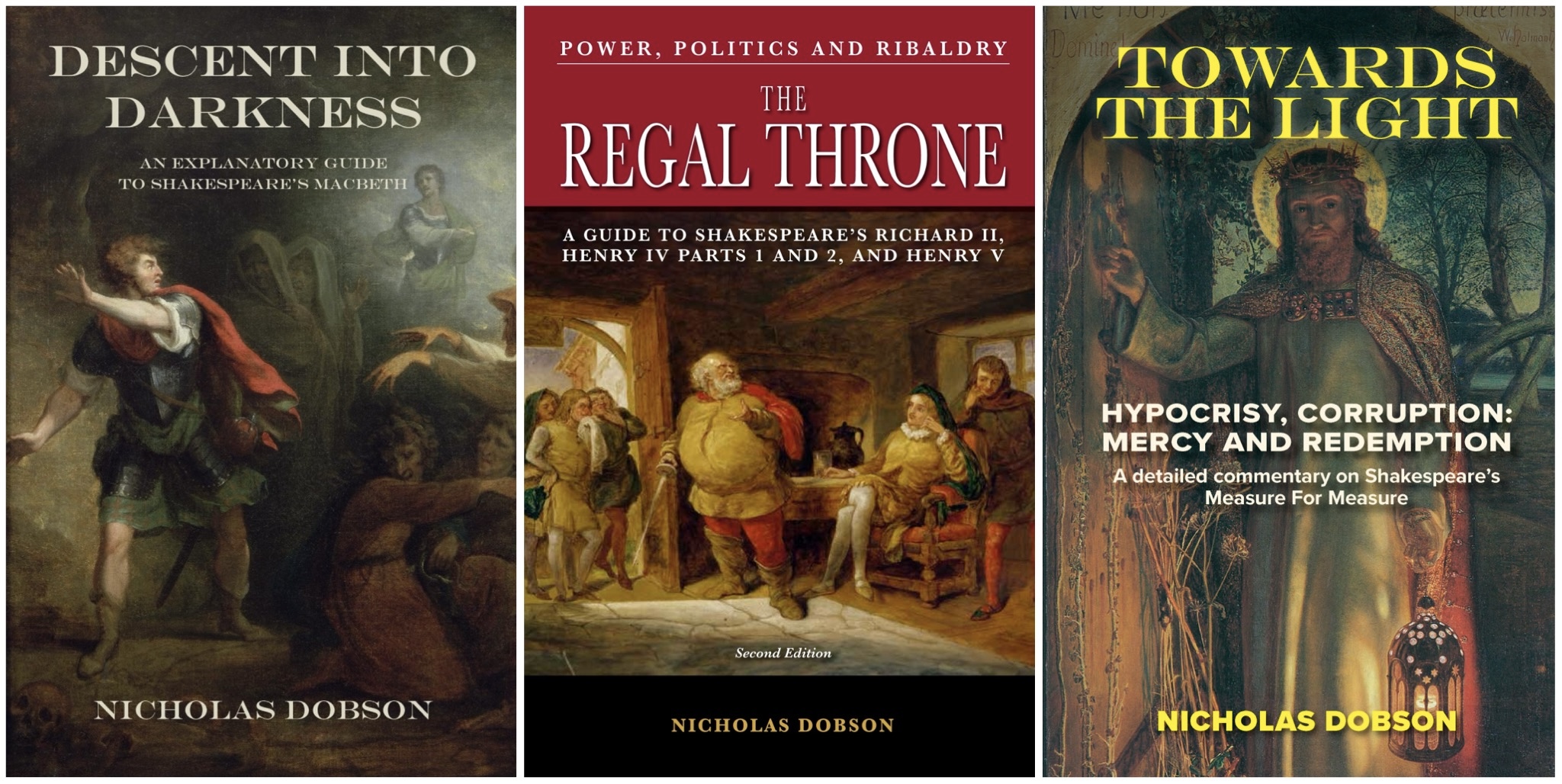
Nicholas is the author of The Regal Throne, Descent Into Darkness, and Towards the Light, which are all part of his Shakespeare in Detail series. Through these books, he hopes to bring Shakespeare’s great works to life for today’s readers.
Below are extracts from some reviews of my books. Reviews of Towards the Light (and updates of reviews on the other books) will be included as they appear.
Peter Mullen, in the Journal of the King’s English Society wrote:
‘. . .a massive and exhaustive commentary on four of the history plays.
Like [F.R.] Leavis, Dobson treats his subject with a forensic thoroughness. . .Dobson knows what he is about. . .the great value of his book: it gives us entry into the myriad-minded Shakespeare and the result is our enlightenment. . .
For all his meticulous forensics, his words do not get in the way of what is being said. . .His visceral exactness reminds me of Dr. Johnson in his Live of the Poets. . .
This – unashamedly dense – book is a revelation of the contents of the mind of our greatest dramatist and of the ages and influences which created that mind.’
Malcolm Hebron, former editor of The Use of English, the journal for teachers of English in secondary and further education wrote that:
‘In The Regal Throne, Nicholas Dobson provides a compendious guide to the pleasurable comprehension of Shakespeare’s so-called tetralogy from Richard II to Henry V. . . I cannot think of any other book which offers such a patient and meticulous commentary of the plays, carefully phrased throughout. I taught all of these plays several times, and thought I knew them well, but thanks to Dobson’s guidance I made many new discoveries and enjoyed numerous moments of clarification . . . It is not only text that is illuminated by The Regal Throne, but the human drama of the plays. . . a student could use this book to revise a particular scene or even speech with ease, as the book is well signposted and simple to navigate. . . ‘
In The Use of English (the journal for teachers of English), Malcolm Hebron, artist, writer, lecturer, former English teacher, editor and examiner, wrote that in Descent into Darkness on Macbeth:
‘Dobson offers us a guide to the play which is solid, rigorous, historically grounded and which arms us for any contemporary debate and indeed any viewing. . . .It does what it sets out to do, explain the text of Macbeth in a clear and immensely informed manner. Seasoned readers (I flatter myself I am one) will learn much from it (I certainly did); younger readers will find a lucid description of any speech and scene they are preparing and at least have a peep at the range of mountains beyond. . .any reader, especially younger ones, will have their expression enriched and fortified by the vocabulary and phrasing. It is a valuable and compendious addition to the already mighty literature on the Scottish play, and I commend it to the readers of this journal.’
Journal of the King’s English Society – Gillian Scholey
This book should be essential reading for anyone who wants a crystal-clear understanding of Macbeth. It would particularly benefit every actor, director and educator who wishes to understand not just the language of the play but also the motives of all the characters, for in this book the paper characters become people with all the foibles and insecurities that mortal men (and women!) experience in life.
The notes are intriguing, incredibly detailed, and attest to the stunning amount of research that Dobson has undertaken. They are of as much value as the main text.
Macbeth is analysed at contextual, scene, line and word level. This also includes the stage directions. Even seemingly minor utterances are examined. However, Dobson goes further and explains the feelings and intentions behind each character’s words so that the reader feels as if he inside the head of each character. This is no mean feat.


 APS BOOKS/APS PUBLICATIONS